Integration of Science and modern Technologies to address Water-related challenges and improve the management of glaciers and glacial lakes
- Sunday, Oct 25 2026
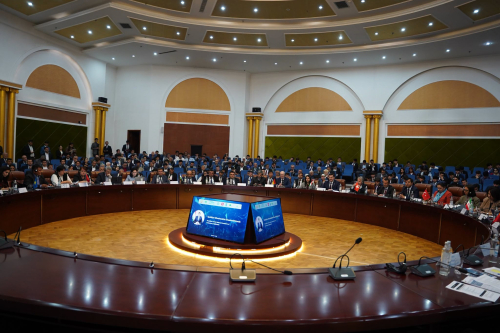
Today, October 22, an international conference entitled “Integration of Science and Modern Technologies to Address Water-Related Challenges and Improve the Management of Glaciers and Glacial Lakes” was held at the National Library of Tajikistan on the initiative of the Institute of Water Problems, Hydropower and Ecology of the National Academy of Sciences of Tajikistan.
The President of the National Academy of Sciences of Tajikistan, Academician Kobiljon Khushvakhtzoda, stated in his opening remarks that the topic of the conference is not limited to the study of a single component of nature. It encompasses issues related to the interconnectedness of natural systems, environmental security, sustainable development, and the socio-economic future of our region. Therefore, addressing such issues is impossible without the development of modern science, interdisciplinary research, digital technologies, and cooperation among scientific institutions of the countries in the region.
It was emphasized that one of the main tasks of the National Academy of Sciences of Tajikistan is to develop fundamental and applied research, strengthen the country's scientific capacity, train highly qualified specialists, and provide scientific findings to address important economic, social, and environmental challenges. Under current conditions, science should not be limited merely to describing natural processes. Science must be capable of identifying changes in a timely manner, forecasting potential developments, and providing a reliable foundation for informed decision-making at the national and regional levels.
It was noted that these requirements are particularly important in the field of water resources and cryosphere studies. Glaciers are among the main sources of river runoff formation in Tajikistan, and changes in their condition affect the hydrological regime, economic activities, energy, agriculture, and environmental security of the region. Therefore, glacier studies should be coordinated with hydrological, meteorological, geological, environmental, and geophysical research.
It was mentioned that Tajikistan's international initiatives in the fields of water and climate have also created an important foundation for the development of scientific research. At the initiative of the Republic of Tajikistan, the United Nations General Assembly proclaimed international years related to water, the International Decade for Action “Water for Sustainable Development”, 2018–2028, the International Year of Glaciers' Preservation 2025, and the Decade of Action for Cryospheric Sciences, 2025–2034.
It was stated that the Republic of Tajikistan consistently promotes the issues of glacier preservation and cryosphere studies at the international level. In this regard, the initiative of the President of the Republic of Tajikistan, Leader of the Nation, His Excellency Emomali Rahmon, to establish a Regional Coordination Centre for Glaciology in Dushanbe under the auspices of the World Meteorological Organization and in cooperation with development partners is of particular importance.
During the continuation of the conference, the Director of the Institute of Water Problems, Hydropower and Ecology of the National Academy of Sciences of Tajikistan, Aminjon Gulahmadzoda, and other scientists and researchers discussed pressing issues of climate change, the current state of water resources, the impact of global warming on glaciers, the condition of glacial lakes, and the need to use modern technologies in their research and monitoring.
During the conference, particular attention was paid to the use of digital technologies, satellite data, geographic information systems, modern hydrological modelling methods, and ways to prevent potential risks associated with glacier melting and glacial lake outburst floods.


