Strengthening Tajikistan–China scientific cooperation in water, climate and hydropower: IWPHE NAST in Shanghai and Wuhan
- Monday, Nov 16 2026
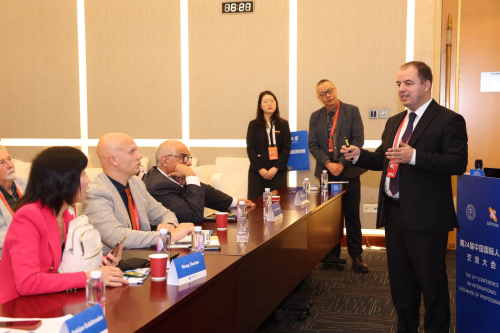
From 10 to 15 November 2026, Dr. Aminjon Gulahmadzoda, Director of the Institute of Water Problems, Hydropower and Ecology of the National Academy of Sciences of Tajikistan (IWPHE NAST), made a working visit to the People’s Republic of China. He took part in the 24th Conference on International Exchange of Professionals (CIEP 2026) in Shanghai at the invitation of China University of Geosciences (Wuhan).
 CIEP 2026: a global forum of talent and science
CIEP was founded in 2001 and is one of China’s largest national forums on science, technology and talent. It is hosted by the Ministry of Human Resources and Social Security of the PRC (State Administration of Foreign Experts Affairs) and the Shanghai Municipal People’s Government. This year’s slogan was “Gathering the Global Talents, Pursuing Win-Win Cooperation”. About 150 exchange events were planned and more than 3,100 international experts were expected to take part.
 Tajikistan’s report in Shanghai
On 12 November, Dr. Aminjon Gulahmadzoda presented “The Tajikistan Mountain Water System under Climate Change” at the plenary session on geological hazards and global governance. Tajikistan was the only Central Asian country among the session speakers. The report covered glacier change, climate projections, river runoff and drought early warning in Tajikistan, based on peer-reviewed research carried out jointly with Chinese partners.
 Climate models with an IPCC expert
A highlight of the visit was working with Prof. Jose A. Marengo, a world-renowned climate scientist, author of IPCC assessment reports and a co-author of joint research with IWPHE NAST and CUG. They discussed:
 how well global climate models (MIROC, HadGEM, ECHAM/MPI) represent the Pamir; downscaling methods for complex mountain terrain; using the next generation of climate simulations, CMIP7, to project glaciers, snow, river runoff and water availability in Tajikistan.
 Meetings with scientists from 14 countries
 Australia: Prof. Gregory A. Houseman
 Austria: Prof. Christoph von Hagke
 Canada: Prof. T. Mark Harrison and Dr. Xiaolan Wang
 France: Prof. Bilal U. Haq (Sorbonne University) and Prof. André Revil
 Greece: Prof. Georgios E. Christidis
 India: Dr. Yunus Ali Pulpadan
 Italy: Prof. Lorenzo Brezzi
 Netherlands: Prof. Jan R. Wijbrans

 Peru/Brazil: Prof. Jose A. Marengo
 Republic of Korea: Prof. Taesung Kim and Prof. Jungyul Park
 Switzerland: Prof. Taras Gerya
 United Kingdom: Prof. Dorrik Stow
 China: leading professors of China University of Geosciences
 CUG: the world’s No. 1 in Earth Sciences
China University of Geosciences was founded in 1952 and is a “Double First-Class” national key university:
 No. 1 worldwide in Earth Sciences (U.S. News 2026)
 No. 2 in Earth Sciences, No. 3 in Remote Sensing and No. 8 in Water Resources Engineering (ShanghaiRanking GRAS 2026)
 No. 10 in Geology (QS 2026)
 3 State Key Laboratories, a National GIS Engineering Research Center, a National Field Research Station for Geohazards, and 34 academic disciplines
 Wuhan: towards a Joint Laboratory
The delegation was officially welcomed at CUG’s National Engineering Research Center of Geographic Information System (NERCGIS). This is the center behind China’s MapGIS platform, and it has provided geospatial support for the safe return of every crewed Shenzhou spacecraft from Shenzhou-5 to Shenzhou-19. Meetings were held with:
Prof. Chen Nengcheng, Director of NERCGIS Prof. Zhang Xiang, representative of the National Natural Science Foundation of China (NSFC) Prof. Guan Qingfeng, Director of the International Cooperation Office of CUGMain results:
 A proposal to establish a Joint Laboratory of Geospatial Intelligence between the National Academy of Sciences of Tajikistan and China University of Geosciences, which was supported by the university leadership. Negotiations were held with the representative of the National Natural Science Foundation of China (NSFC). It was agreed that the National Academy of Sciences of Tajikistan will submit a partnership application to NSFC, and the NSFC representative will assist in registering NAST as an NSFC partner institution. This will open the way for NSFC support of future joint Tajik–Chinese research projects. The laboratory would build on long-standing cooperation under the Ministry of Science and Technology of China (MOST) and the National Natural Science Foundation of China (NSFC). Exchanges of young scientists and PhD students, joint supervision, and training in remote sensing, GIS and hydrological modelling. A first-hand look at advanced Chinese technologies: digital twins, GeoAI models for landslide early warning, and intelligent sensing with drones, robots and environmental sensors.
Why it matters for Tajikistan
This cooperation supports the global water and climate initiatives of the Founder of Peace and National Unity – Leader of the Nation, President of the Republic of Tajikistan, His Excellency Emomali Rahmon. These include the International Decade for Action “Water for Sustainable Development” 2018–2028, the International Year of Glaciers’ Preservation 2025 and the Decade of Action for Cryospheric Sciences 2025–2034.
The results of the visit will contribute to the strategic documents and goals of the Republic of Tajikistan:
 the National Development Strategy of the Republic of Tajikistan for the period up to 2030;
 the National Water Strategy of the Republic of Tajikistan for the period up to 2040 and its Action Plan for 2025–2027;
 the National Climate Change Adaptation Strategy of the Republic of Tajikistan for the period up to 2030 and its Action Plan for 2025–2027;
 the State Glacier Observation Network;
 the National Strategy of the Republic of Tajikistan for Disaster Risk Reduction for 2019–2034;
 the strategic goal of achieving energy independence through the development of hydropower;
 ensuring food security and agricultural development, including efficient irrigation;
 the State Greening Programme of the Republic of Tajikistan for the period up to 2040; the State Target Programme for the Development of Mathematical, Exact and Natural Sciences for 2026–2030.


