Tajikistan at the 30th session of ICC-PRESAP, UN ESCAP: space technology for drought early warning
- Friday, Oct 30 2026
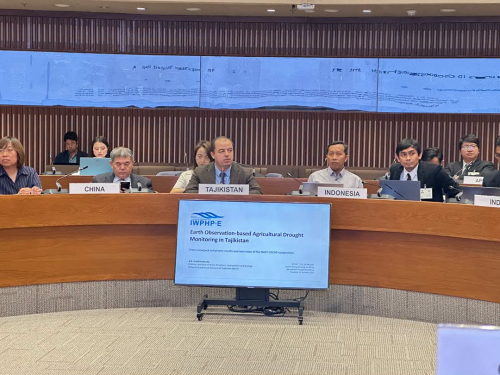
On 26–27 October 2026, the United Nations Conference Centre in Bangkok hosted the Thirtieth Session of the Intergovernmental Consultative Committee on the Regional Space Applications Programme for Sustainable Development in Asia and the Pacific (ICC-30, RESAP). The session was organised by the United Nations Economic and Social Commission for Asia and the Pacific (ESCAP).
The session was attended by Dr. Aminjon Abdujabbor Gulahmadzoda, Doctor of Technical Sciences, Director of the Institute of Water Problems, Hydropower and Ecology of the National Academy of Sciences of Tajikistan.
Two presentations and concrete proposals
Dr. Gulahmadzoda delivered two presentations:
"Earth Observation-based Agricultural Drought Monitoring in Tajikistan: From Snowpack to Harvest" covered the results of cooperation between the National Academy of Sciences of Tajikistan and ESCAP.
"Tajikistan: Towards Operational Drought Monitoring" presented the work completed on capacity development, field validation and digital innovation.
Tajikistan's key proposals:
 Establish the Drought Monitoring Laboratory of the National Academy of Sciences of Tajikistan together with UN ESCAP Implement a pilot project in Khatlon region in 2027–2028 to issue seasonal drought outlooks Link satellite data to the implementation of the National Water Strategy to 2040 and the Climate Adaptation Action Plan 2025–2027
Adopted conclusions and recommendations
The Committee adopted conclusions and recommendations. They cover the use of artificial intelligence and satellite data for early warning of droughts, floods and glacial lake hazards, capacity building for young scientists, and support for the Fifth Ministerial Conference on Space Applications (28–29 October 2026).
At Tajikistan's initiative, an invitation was included in the session's conclusions and recommendations. ESCAP and international partners are invited to jointly organise an event on space applications for water scarcity, glacier monitoring and disaster risk reduction during the United Nations Conference on the Final Comprehensive Review of the International Decade for Action "Water for Sustainable Development", 2018–2028. The conference will take place in Dushanbe, Tajikistan, on 4–6 May 2028. It will be an excellent opportunity to showcase innovative solutions and strengthen regional cooperation for sustainable water management and climate resilience.
Expert Group Meeting on Drought Monitoring in Central Asia
The meeting presented ESCAP's technical report, with experts from India, China, Kazakhstan and the World Meteorological Organization taking part. In the panel discussion, Jafar Niyazov and Abduvosit Makhmudov, researchers at the Institute of Water Problems, Hydropower and Ecology, shared Tajikistan's experience. Said Sharipov, also a researcher at the Institute, was acknowledged as an expert reviewer of the new English–Russian terminology database on drought monitoring, which contains more than 1,100 terms.
Tajikistan is the main water source of Central Asia and a recognised global champion of the water agenda. Applying space technology to drought early warning and glacier monitoring is an important contribution to water, food and climate security across the region.


