 English
 Тоҷикӣ
 Русский

Tajikistan participates in the fifth ministerial conference on space applications for sustainable development in Asia and the pacific
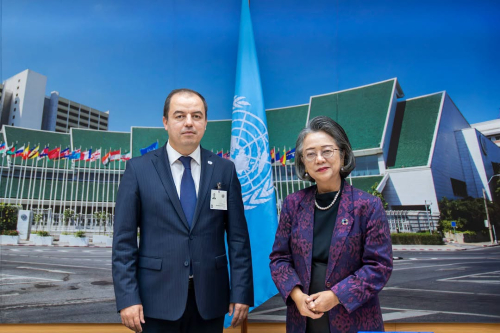
The Fifth Ministerial Conference on Space Applications for Sustainable Development in Asia and the Pacific was held on 28–29 October 2026 at the United Nations Conference Centre in Bangkok. The Conference was organized by the United Nations Economic and Social Commission for Asia and the Pacific (ESCAP), in collaboration with the Government of the Kingdom of Thailand. Delegations from 30 member States, along with representatives of United Nations entities and international organizations, participated in the event. The Conference was preceded by the 30th session of the Intergovernmental Consultative Committee on the Regional Space Applications Programme for Sustainable Development.
The National Academy of Sciences of Tajikistan was represented at these high-level events by Gulahmadzoda Aminjon, Doctor of Technical Sciences and Director of the Institute of Water Problems, Hydropower and Ecology of the National Academy of Sciences of Tajikistan. He participated as the Academy’s authorized representative, designated by its President, Academician Khushvakhtzoda Qobiljon Khushvakht.
Meeting with the Executive Secretary of ESCAP
On the sidelines of the Conference, Dr. Gulahmadzoda met with Her Excellency Ms. Armida Salsiah Alisjahbana, United Nations Under-Secretary-General and Executive Secretary of ESCAP.
During the meeting, he expressed his appreciation for ESCAP’s continued support for Tajikistan and its initiatives. He particularly acknowledged Ms. Armida Salsiah Alisjahbana’s participation in the forum “Water and Climate Risks: Science, Monitoring and Management,” organized by the Institute of Water Problems, Hydropower and Ecology during the Fourth High-Level International Conference on the International Decade for Action “Water for Sustainable Development,” 2018–2028, held in Dushanbe in May 2026.
The two sides discussed opportunities to strengthen scientific and regional cooperation in water resources management, glacier monitoring, climate change adaptation and the application of space technologies.
As a gesture of friendship and respect, Gulahmadzoda Aminjon also presented Ms. Armida Salsiah Alisjahbana with a collection of semi-precious stones from Tajikistan.
Tajikistan’s Statement and Priorities for Regional Cooperation
Under the agenda item “Harnessing space applications for a resilient and inclusive future through enhanced regional cooperation,” Gulahmadzoda Aminjon delivered a statement on behalf of the Republic of Tajikistan.
He emphasized that satellite observations, Earth observation and remote sensing technologies, and artificial intelligence offer significant opportunities to monitor water resources, assess glacier conditions, evaluate the impacts of climate change and reduce disaster risks.
On behalf of the Republic of Tajikistan, he outlined three priority areas for regional cooperation:
1. Establishing a regional satellite-based initiative for water resources and glacier monitoring. The initiative could cover glaciers, snow cover, river flows, reservoirs and the assessment of water availability.
2. Developing an integrated regional early warning system for climate-related and water-related hazards. The system would combine satellite imagery, meteorological data, digital elevation models and real-time monitoring information to strengthen countries’ preparedness for natural disasters.
3. Expanding access to satellite data, promoting joint scientific research and strengthening capacity. This priority is particularly important for scientific institutions in developing countries, including countries with mountainous terrain.
The statement highlighted Tajikistan’s readiness to share its scientific expertise, knowledge and experience in water resources assessment and management with countries across the region. It also emphasized that the benefits of space technologies and satellite-derived data should be accessible to all countries, regardless of their technical and financial capacities.
Tajikistan’s Experience Featured in an ESCAP Publication
During the Conference, ESCAP presented Geospatial Practices for Sustainable Development in North and Central Asia 2026: A Compendium. The publication brings together 100 regional examples, including Tajikistan’s experience in the following areas:
-
flood forecasting;
-
glacial lake monitoring;
-
multi-hazard early warning systems;
-
geohazard assessment;
-
infrastructure vulnerability assessment;
-
mapping of water infrastructure.
The inclusion of Tajikistan’s experience in this regional publication highlights the importance of geospatial information and modern technologies in natural hazard management and sustainable development.
Conference Outcomes and Prospects for Cooperation
The Conference concluded with the adoption of the Bangkok Ministerial Declaration on Space Applications for Sustainable Development in Asia and the Pacific. The Declaration establishes the basis for Phase III of the Regional Plan of Action for 2026–2030 and emphasizes the role of Earth observation in climate action, disaster risk reduction and the sustainable management of water resources.
The participation of the representative of the National Academy of Sciences of Tajikistan in this high-level Conference contributes to promoting the country’s scientific capabilities internationally, expanding international partnerships and strengthening regional cooperation in space applications, glacier research, water resources management and climate change adaptation.


